Pepper • 2025
Gamification of daily engagement
Role
Product Design Intern
Timeline
2 Months
Skills
Prototyping
Feature Design
Gamification
Overview
What is Pepper?
Pepper is a recipe-based app, built around browsing, following, and sharing recipes. Charcuterie is a lighter, gamified layer inside that core product: users build virtual charcuterie boards as a fun way to engage with food content without the commitment of a full recipe. Daily Trivia extends that same gamification layer, replacing the old free-item feature with something that also teaches real culinary knowledge.
Problem
Free item wasn't building a habit
The old free-item giveaway was a one-time transaction with no reason to come back the next day. It didn't teach users anything and didn't build repeat engagement. The goal was to design a format simple enough to repeat daily, but with enough depth to actually reinforce culinary knowledge over time.
Solution Preview

Daily Trivia scren

Answering cuestions correctly

Holiday variant designs
Research
What the founder actually wanted
Coming into this project, the founder's priority wasn't just "replace the free item," it was specifically that the replacement have an educational component. Pepper is a recipe app first, so any new engagement mechanic needed to reinforce that identity, not just be engagement for engagement's sake.
Concepts Explored

Gacha Wheel Spin
A randomized item drop, spin the wheel, get a reward. High engagement potential, but purely luck-based and it edged uncomfortably close to gambling mechanics.

Trivia Questions
Ties the reward directly to a piece of real culinary knowledge. It satisfied the CEO's actual ask, and it kept the "low-friction, repeatable" requirement intact.

Daily Streaks
Rewarding consecutive days of engagement rather than any single action. This would be tied to a specific action like saving recipes or even doing the trivia .
Final Decision
Trivia was prioritized and moved into active design and development. The wheel-spin concept was deprioritized, it came down to the CEO's stated goal: engagement that teaches something beats engagement that doesn't, even if the latter might have tested better on raw novelty.
Streaks stayed on the side as a self-directed build. At the end of the project, I presented it to the founder, who responded well enough that it's now moving into its own development track.
Discovery
Personally using the platform
Before I started designing anything, I wanted to actually use Pepper the way a real user would, not just look at it as a spec to build against. I'd just moved into a dorm with a real kitchen, which meant for once I could actually cook instead of just reading recipes on a screen. So for about a week, I used Pepper the way an actual user would: browsing recipes, cooking a few of them, and poking around the charcuterie feature in between.

Rose tteokbokki

Crispy pork belly

Sweet and spicy chicken
Where trivia would slot in
The best time to use Daily Trivia wasn't while cooking, it was during the dead time waiting for food to finish, the same moments I'd otherwise spend idly scrolling recipes. Trivia filled that gap well: a quick, fun distraction that didn't compete for attention while I was actually cooking.
Design
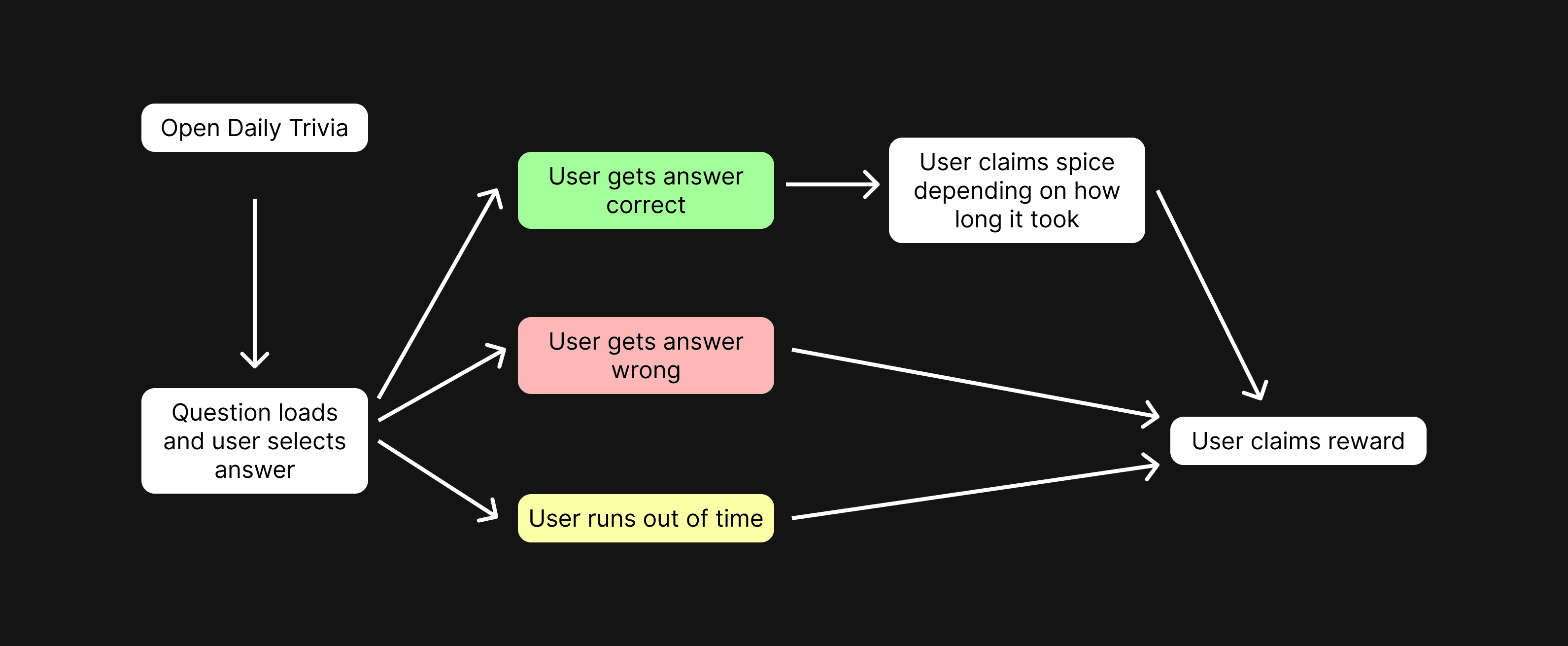
User flow
Design Decisions
How do we stay playful?
We wanted a way for the language and appearance to stay playful for encouraging tonality


How do we treat right or wrong answers?
We wanted everyone to claim a prize after regardless of correctness but reward those who got the answer correct with extra spice (which could be used to buy specific items)

Positive reinforcement for repeated behavior
Re-exploring the streaks idea I really liked, I proposed a small design that would appear when the user logs back to try on consecutive days

Prototype
A full design of the feature
From all user flows and exceptions


Reflection
Key Takeaways
Trust your gut
If you have a feature you truly believe in (like the streaks feature), go and work on it on the side without compromising your main task. You never know if a rejected idea becomes a great idea down the line.
You are your best user
The time I took to get familiar with the app was more helpful than any amount of pages that described the product. Using what you will design on will build a foundation that is more relatable than going in blind.